
The Candy House
One Bad Film After Another


There is an almost obscene clarity in the fabulation of a fairy tale. Jacob and Wilhelm Grimm’s “Hansel and Gretel” tells the story of two children who are abandoned in a forest and fall into the hands of a witch. The witch lives in a house made of bread, cake, and sugar, whose sweet walls, as it were, resemble Hollywood and streaming services, while the audience, left in a forest of poor choices, has totally lost the memory of the path back.
Susan Sontag saw the decline of the cinema as a sign of its broader deterioration in an account of what happens when the screen becomes empty and images are consumed mechanically.
The contract has now been torn up and rewritten. The ritual of the cinema has been replaced by a domestic drift where the image is, at best, background noise, and psychological and relational flatness, two-dimensional-going-on-one-dimensional renditions have replaced everything else. Okay, there’s always been bad movies, but what has fundamentally changed is the possibility of them creating meaning. And it all started with the elimination of duration as “universal becoming,” as a force that sparks imagination.
Time used to be a central element in film. In the preface to Cinema 2: The Time-Image, Gilles Deleuze points to the fact that classical cinema (the movement-image) structures time through action and a sensory-motor perception-feeling chain. Modern cinema (the time-image) takes shape when this chain loosens and situations arise in which characters no longer know how to react, so that time itself becomes a tangible, observable phenomenon. “The plane of movement-images is a bloc of space-time, a temporal perspective, but, in this respect, it is a perspective on real Time which is not at all the same as the plane [plan] or the movement,” writes Deleuze in Cinema 1: The Movement-Image.
Cinema can convey action but also a perceptual possibility. The bareness between events, the gritty, unyielding texture of time. Deleuze sees it as the body’s shift from a mere instrument of action to a vessel that develops temporality through its pauses and fatigue. Andrei Tarkovsky says that cinema is time “captured in its factual forms and manifestations.” Film to him is an art capable of “printing” time, a sculpture whose medium is duration instead of marble.
What did I once seek in cinema, before the sugar? O, but it was the printed time, the image that compelled me to inhabit time as it consumed me, instead of simply me consuming it. I wanted the screen to go beyond storytelling. I wanted it to be a bridge to the world, as well as to the inner labyrinth of my mind, to memory, fear, desire, to the brutal fact of being alive.
This is why a certain constellation of filmmakers is still relevant, as they are engineers of a different kind of filmic experience that’s been rendered obsolete, so much so that, when watching their work now, it seems to belong to a completely different medium, to an altogether different dimension. Andrei Tarkovsky creates sequences where surfaces become the pattern of unconscious thought, with water, rust, bark, grass, fog, sand, the slow burn and the lingering shots serving as a form of ethics, as a cinematic belief system. Michelangelo Antonioni explores emptiness as event, depicting modern alienation as an incessant spatial and temporal drift rather than traditional plot point. Federico Fellini turns memory and fantasy into a chaotic, frenetic bazaar of the psyche.
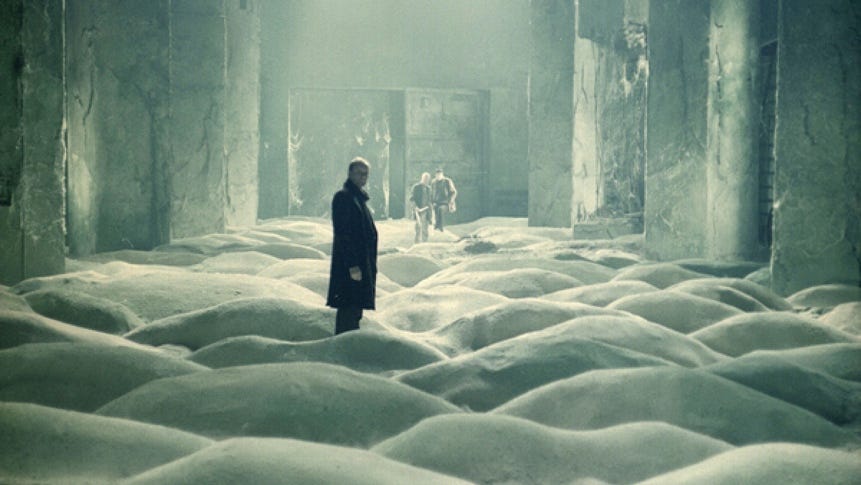
Tarkovsky Stalker, 1979
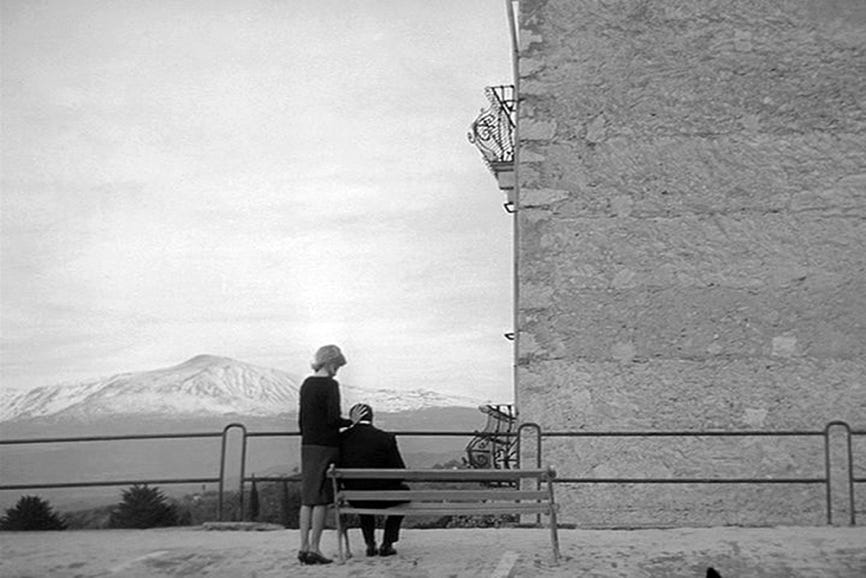
Antonioni L’avventura, 1960
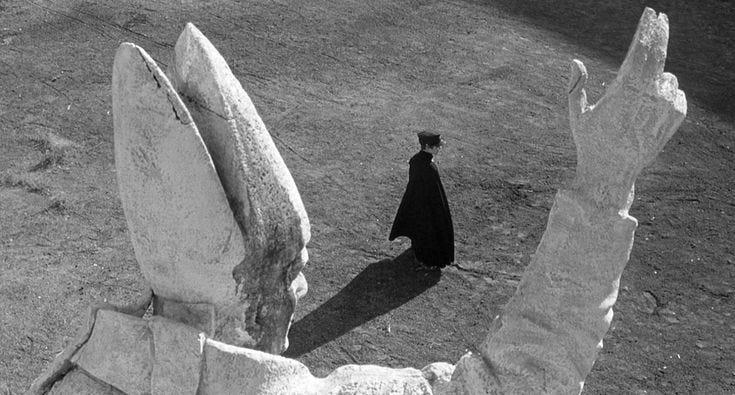
Fellini 8 1/2, 1963
This cinema, now dismissed as boring, is one of the gates through which attention deepens sufficiently to perceive time. Because boredom is the site of revelation. Contemporary cinema, by comparison, sits at the other end of the spectrum. New releases must cater (as much as I hate using the word) to audiences who struggle to maintain prolonged focus, resulting in rapid sequences of shots designed to keep them engaged and stimulated.
Sontag, long ago, elevated “transparence” as the experience of the thing itself, luminous, irreducible, because vision is never just a matter of my sovereign looking; something in the visual field escapes me and, counterintuitevely, looks back, implicates me in the desire of the other, the gaze denotes a split in perception, an intrusion of the real into the visible.
After the 70s, the industry learned how to reduce risk by (re)programming desire. The open image was replaced with the managed image. Cinema was reduced from an event, an encounter, to a brand, the factory of cheap sensations it is today. Cinema as art was repurposed to become the opposite. Of course, there is still beauty in the world and art films can still be made. What’s been stamped out is the cultural position of cinema in the role of a central public art of thinking in images, and the really difficult question we’re faced with is: would there even be an audience for it now that its tools for perception and seeing have been disabled?
It is the writers of modern films who deserve the blame. Most films are cotton candy for the brain. Throw in Hollywood's woke, political correctness, and virtue signaling and what you got ladies and gentlemen, is nada.
Oh yes! How I miss those kinds of films being made today, like so many things. Brava!